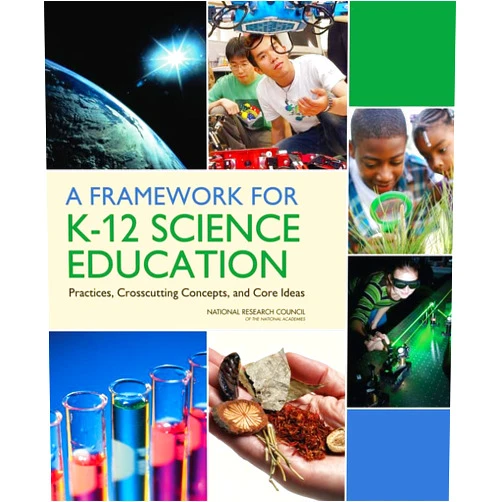
Ignite Young Minds, Inspire Future Scientists!
A Framework for K-12 Science Education: Practices, Crosscutting Concepts, and Core Ideas sparks a scientific revolution in the classroom! This groundbreaking framework, crafted by the National Research Council, Division of Behavioral and Social Sciences and Education, Board on Science Education, and Committee on a Conceptual Framework for New K-12 Science Education Standards, guides educators and students alike on a thrilling journey through the wonders of science. Discover how to ignite curiosity, foster critical thinking, and build a solid foundation for future scientific endeavors.
Main Features
- Integrates Core Ideas: The framework weaves together essential scientific core ideas from the physical sciences, life sciences, earth and space sciences, and engineering. This ensures a comprehensive and cohesive science education experience.
- This feature structures how students are taught science concepts in various fields, providing a connected understanding.
- Emphasizes Crosscutting Concepts: It highlights crosscutting concepts that link different scientific disciplines, such as patterns, cause and effect, and systems.
- This focus helps students see how scientific principles apply across all scientific fields.
- Focuses on Science and Engineering Practices: It spotlights key science and engineering practices like asking questions, analyzing data, and designing solutions, promoting hands-on learning.
- This feature encourages active learning and allows for applying scientific concepts through practical activities.
- Supports Three-Dimensional Learning: It encourages a three-dimensional approach, blending core ideas, crosscutting concepts, and science and engineering practices.
- This three-dimensional method aims for a deeper, more meaningful learning experience.
- Promotes Inquiry-Based Learning: The framework encourages student-driven inquiry and exploration to foster a love for science.
- This fosters curiosity and discovery through investigations.
Benefits
- Develops Critical Thinking Skills: The framework strengthens critical thinking skills by encouraging students to analyze information, solve problems, and make informed decisions.
- Students learn to question, evaluate, and draw conclusions based on evidence.
- Cultivates Scientific Literacy: It cultivates scientific literacy, equipping students with the knowledge and skills they need to navigate a science-driven world.
- It prepares students to understand scientific concepts and how they apply to everyday situations.
- Enhances Problem-Solving Abilities: It enhances problem-solving abilities, empowering students to tackle complex challenges with creativity and innovation.
- Students learn to approach problems systematically and think outside the box.
- Inspires STEM Interest: The framework will inspire and grow interest in science, technology, engineering, and mathematics (STEM) fields.
- It motivates students to explore scientific careers and pursue their passion.
- Prepares for Future Success: It prepares students for future success in higher education and the workforce by providing a strong science foundation.
- This guarantees that students are ready for the rigor of science-based courses and STEM related careers.
Unique Selling Points / Competitive Advantages
- Nationally Recognized: It's a framework developed by the National Research Council, a trusted and respected organization in science education.
- This gives the framework a high level of credibility and reliability.
- Research-Based Approach: It is based on the latest research in science education and cognitive science.
- This makes certain that the framework is based on effective teaching strategies.
- Comprehensive Coverage: It offers a comprehensive overview of essential science concepts and practices across all K-12 grade levels.
- The framework offers a full and thorough guide to science education.
- Emphasis on Engagement: It emphasizes engaging teaching strategies and hands-on learning experiences.
- This leads to more active student participation.
- Adaptive and Flexible: It provides a flexible framework that can be adapted to meet the needs of diverse learners and educational settings.
- This makes it versatile for a variety of users.
Usage Scenarios
- Classroom Curriculum Development: Teachers can use it to design engaging science curricula aligned with national standards.
- This aids teachers in developing appropriate and useful lesson plans.
- Professional Development: It is perfect for teacher training and professional development programs to help educators stay current with science education best practices.
- This makes sure that educators are always enhancing their understanding and abilities.
- Lesson Planning: Teachers use it as a guide to create innovative and effective lesson plans, covering a variety of science subjects.
- This helps teachers make sure their lessons are suitable for the classroom.
- Assessment Design: Educators can use it to design assessments that measure student understanding of science concepts and practices.
- This helps them understand the comprehension of the students.
- Parent-Teacher Communication: Parents and teachers can use the framework to communicate about student progress and foster a shared understanding of science learning goals.
- This boosts cooperation between parents and teachers.
Customer Reviews / Testimonials
- Maria, Mexico, 2022: "I found this framework invaluable for designing my science lessons. The emphasis on hands-on activities really resonates with my students!"
- David, Canada, 2021: "As a school administrator, I implemented this framework across our science program, and the results are amazing. Students are more engaged, and teachers love it!"
- Aisha, India, 2023: "This framework has helped me to truly understand how to teach science to my young kids. My kids love the experiments."
- Kenji, Japan, 2020: "The framework's focus on critical thinking has changed the way my students approach problem-solving."
- Sarah, Australia, 2024: "The structure of the framework is easy to follow and the concepts are well explained. It’s perfect for new science teachers like me!"
Frequently Asked Questions
- Q: What is the main purpose of this framework?
- A: The main purpose is to guide the development of new K-12 science standards and improve science education across the country.
- Q: Who is the target audience for this framework?
- A: The target audience includes educators, curriculum developers, policymakers, and anyone interested in improving science education.
- Q: How does this framework benefit students?
- A: It benefits students by providing a framework to promote inquiry-based learning, cultivating scientific literacy, and developing essential 21st-century skills.
- Q: Is this framework aligned with national standards?
- A: Yes, it is designed to align with and inform the development of science education standards.
- Q: Is this useful for homeschooling?
- A: Yes, it is a valuable resource for homeschooling families to create a comprehensive and engaging science curriculum.
BUY NOW
Embark on a voyage of discovery with the A Framework for K-12 Science Education, where young minds soar into the captivating world of science! Inspire the next generation of innovators with the bold brand, and unlock the boundless possibilities of knowledge – Start your science adventure today!
(Beta: User Generated 2024.0007)